Matter Separation
Natalie Curcio
Process
-
Funnel
-
Filter paper
-
Water
-
Beaker
-
Test tube
-
Rack
-
Salt
-
Copper sulfate (CuSO4)
-
Alcohol
Materials
Methods
-
Chromatography
-
Filtration
-
Evaportaion
-
Sedimentation
-
Centrifugation
-
Distillation
Centrofugation
1. Prepare the suspension in a beaker and close it.
2. Hold the beaker and make circular motion for a minute.
3. Check if the suspension had separated. If not repeat step #2. The circular motion forces the solid to the bottom of the tube. Then the liquid can be poured off from the solid.
Chromatography
1. Take a rectangular filter paper and draw a line in one end of the paper.
The spots from the mixtures are put on the line.
2. Then the paper is placed on top of an organic solvent, for example alcohol, so that the edge of the paper is touching the solvent. It should be ensured that the line drawn earlier never touches solvent.The solvent will go up the paper and it will dissolve the mixtures of colors. As the mixtures of colors goes up they will be separated. Because different compounds have different affinity (adsorption) for the filter paper. Those with higher adsorption will spread slower than those with lower adsorption.
Distilation
1. Ensemble the distillation tower.
2. Pour mixture in the beaker.
3. Connect the water pump.
4. Make the burner raise the lowest boiling point of the mixture.
5. Continue distillation until all of the first liquid is condensated.
Evaporation
1. Check if the boiling point from the solvent and the solute, place the mixture in a beaker and raise the temperature to the boiling point of the solvent if there is a difference
2. At the end, when the solvent is evaporated, what is left in the beaker is the solute.
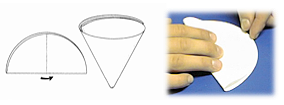
Filtration
Sedimentation
1. Fill pot #1 with water. Cover the top and let it stay for 1 day or more.
2. Pour water from pot #1 to pot #2. Don't pour out any of the sediment that has stayed into the bottom. Cover pot #2 and leave it for 1 day or more.
3. Pour the clear water from pot #2 into empty pot #3, making sure not to disturb the sediment at the bottom of pot #2.
1.
2.
